

Can You Sue God? Three Times People Actually Tried
When something goes wrong, lawsuits usually begin with a fairly basic question: Who is responsible? A driver. A company. A property owner. Maybe even the government.
But what happens when the alleged culprit is a little harder to serve with court papers?
Over the years, plaintiffs in the United States and abroad have attempted to take God to court, blaming the Almighty for everything from natural disasters to one man’s inability to
“resist the influence of Satan.” Unsurprisingly, the cases created some unusual legal problems.
For this edition of Trial and Terror, we’re looking at three lawsuits that asked courts to answer questions they probably never expected to encounter.
Betty Penrose v. God: An Act of God Goes to Court
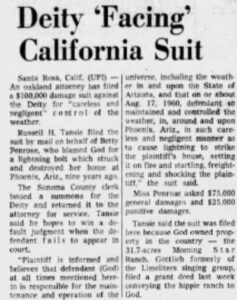
Indianapolis Star – May 14,1969
The phrase “act of God” is familiar enough in insurance policies and legal contracts. In 1969, Betty Penrose apparently decided to take it literally.
Penrose, a legal secretary from Arizona, reportedly lost her home after it was struck by lightning and burned down. Her attorney, Russell Tansie, responded with a rather unconventional theory: If God controlled the weather, then God was responsible for the damage. The lawsuit sought $100,000 and accused God of negligently maintaining and operating the universe, including the weather over Arizona.
There was just one obvious problem. How do you establish jurisdiction over God?
As luck would have it, another unusual legal dispute in California seemed to provide an answer.
Around the same time, musician Lou Gottlieb, a member of the folk group The Limeliters, had attempted to deed his 30-acre Morning Star Ranch in Sonoma County to God. The deed was actually recorded, giving Penrose’s attorney an opening, if God owned property in California, perhaps a California court could exercise jurisdiction over Him.
And so, Penrose’s lawsuit against God was filed in Sonoma County. Some later accounts claim Penrose obtained a judgment after God failed to appear, though there is no indication that she ever collected the requested $100,000.
But even that supposed victory had a problem.
The court dealing with Gottlieb’s ranch later ruled that the deed to God wasn’t legally valid. California law required a grantee capable of taking title, and the court concluded that God couldn’t satisfy that requirement. Which meant the clever jurisdictional theory behind Penrose’s lawsuit had lost its earthly foundation.
God may have been blamed for the lightning. Collecting damages was another story.
Pavel Mircea v. God: A Breach of Contract With the Almighty
Our next plaintiff wasn’t looking for compensation after a natural disaster. He was already serving a 20-year prison sentence for murder.
In 2005, Romanian prisoner Pavel Mircea filed a complaint naming God and the Romanian Orthodox Church, which he identified as God’s representative on Earth. His argument essentially came down to contract law. Mircea claimed that when he was baptized, he had entered into an agreement with God. In exchange for his prayers and religious devotion, he believed God was supposed to protect him from evil. Instead, Mircea argued, Satan had influenced him and helped lead him into the criminal behavior that landed him in prison.
Therefore, in Mircea’s view, God had failed to hold up His end of the bargain.
His complaint reportedly accused God of offenses including fraud, abuse of authority and influence trafficking. A contemporary Romanian report quoted the complaint as identifying the defendant as God, “resident in Heaven,” and represented in Romania by the Orthodox Church. It was certainly one way to frame a breach-of-contract dispute. Romanian prosecutors were less convinced.
The complaint was ultimately rejected. Reports of the decision explained that God wasn’t a legal person or company subject to the court’s jurisdiction and, once again, there was another practical difficulty: No legal address.
The Devil may have made Mircea do it, but the courts weren’t going to make God answer for it.
Ernie Chambers v. God: Please Serve the Defendant
In 2007, Nebraska State Senator Ernie Chambers filed what is probably the most famous modern lawsuit against God. Unlike our previous plaintiffs, Chambers wasn’t expecting a divine payout. His lawsuit was intended to make a point about access to the courts.
Chambers opposed attempts to restrict lawsuits considered frivolous. To demonstrate that anyone should be able to bring a claim to court, he chose perhaps the most ambitious defendant possible: God.
The complaint accused God of causing or allowing disasters including floods, earthquakes, hurricanes, tornadoes, famines and droughts. Chambers sought a permanent injunction ordering the defendant to stop causing destructive acts and terrorizing people.
Chambers had already anticipated one potential jurisdictional problem. God, he argued, was omnipresent. Therefore, God was present in Douglas County, Nebraska.
Case closed? Not quite. There was another more glaring issue: God’s Address.
The lawsuit eventually reached Douglas County District Court Judge Marlon Polk. And the case ran into an obstacle familiar to lawyers everywhere: The defendant hadn’t been properly served. The court concluded that there was no evidence God had received legal notice of the lawsuit. More importantly, the judge determined there was no apparent way that proper service could be completed because God lacked a listed address.
The case was dismissed in 2008. Chambers, however, spotted what he believed was a flaw in the court’s reasoning. If God is omniscient, he argued, then God already knows about the lawsuit. In other words: Why serve court papers on someone who already knows everything? Chambers also pointed to the fact that the court itself appeared willing to acknowledge God’s existence. If God exists and is omnipresent and omniscient, then a lack of notice shouldn’t be a problem. The judge remained unconvinced.
Chambers later pursued an appeal, continuing one of the strangest battles over service of process Nebraska’s courts had probably ever encountered.
Trial and Terror Takeaway
Three plaintiffs. Three very different complaints. And one defendant who proved remarkably difficult to get into a courtroom. While none of the cases proved that a court could hold God legally responsible, they did expose some very earthly problems.
- A lawsuit still needs jurisdiction.
- The defendant needs to live on planet Earth.
Maybe that’s the real lesson here: You can sue just about anybody. But physically getting them into court is another matter entirely.
 The Ouija Board Jury: When Jurors Tried to Contact the Dead